
Product Manual Creation: A Rigid Process Costing Time & Money
A product manual tends to be created the way it always has been: the content is created, the design laid out, translated and then printed for inclusion in the box with the product, and then considered finished. It is a rigid process that nobody has reimagined, costing you time and money.
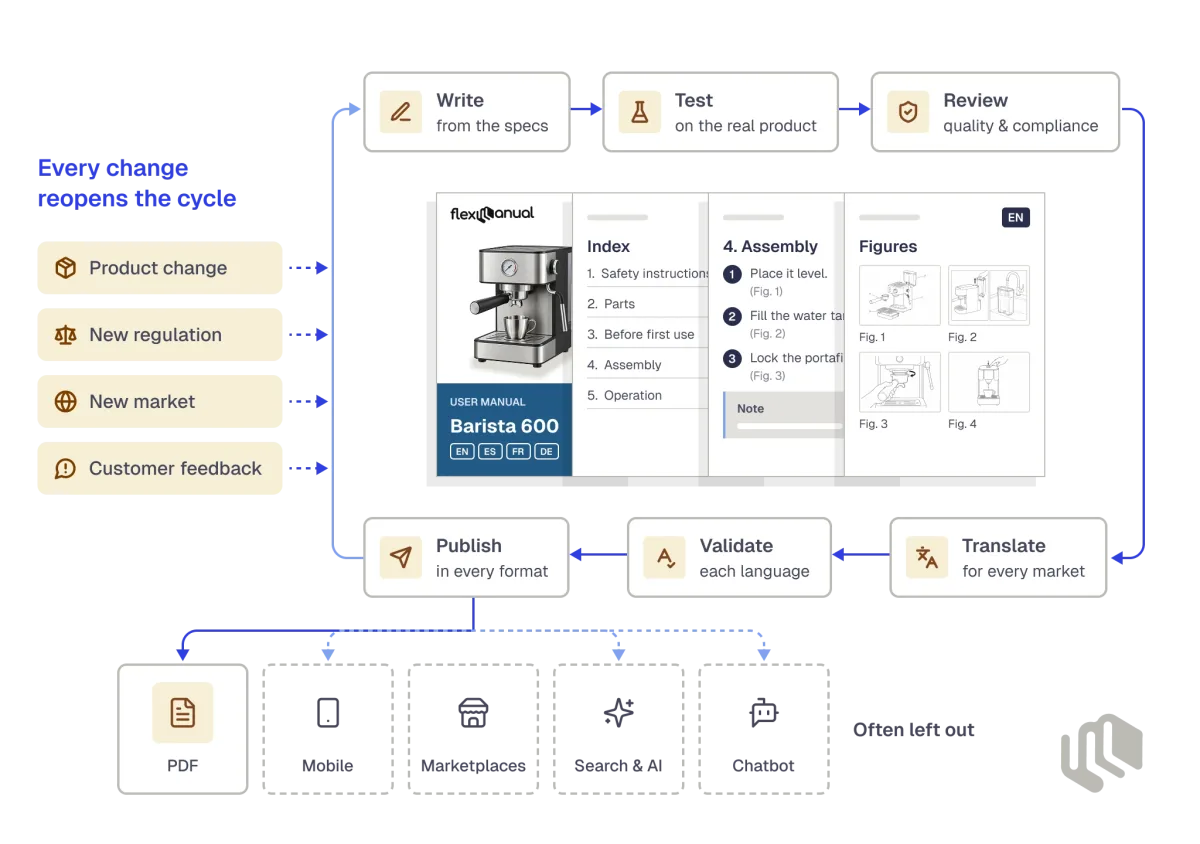
This rigidity shows every time the manual has to change: a correction, a new legal notice, an illustration that no longer matches the part, or another language to enter a new market. Each change means reopening files, coordinating several teams and waiting on their deadlines. And the cost weighs more heavily on brands that sell direct to the customer, on their own website or on marketplaces, where the manual is often the only help available to whoever opens the box, and every error that takes time to fix ends up as a return, support query or negative review.
How the Process Became So Rigid
The process has become rigid over the years for three principal reasons: an outdated idea of what the manual is for, tools that impose their own way of working, and a mental model that nobody has questioned.
An Outdated Idea of What the Manual Is For
When the main sales channel was shops and distributors, the manual's job was to meet regulations and go in the box. If it included the mandatory warnings and fitted in the packaging, it was done. Many processes were designed for that job, before online sales and marketplaces gained ground, and have barely changed since.
Today the manual has to meet many more demands:
- Market regulations everywhere where the product is sold, which change over time.
- Languages for every market.
- Appear in several channels at once: the box, the brand website, each marketplace and the QR code.
- Changes to the product throughout its life, from a new component to an illustration that no longer matches.
- Customer expectations, as people want to assemble or install the product without help and resolve questions months after purchase, when the paper manual is long gone.
Additionally users increasingly ask ChatGPT and other AI assistants how to assemble or use a product, without even opening the original manual. For that answer to be right, the manual has to be openly published, with content those AI can read and interpret. If they cannot find it, they answer with generic invented instructions or, worse still, with those for a competitor's product.
An old process designed to produce solely a document that goes in the box cannot meet all of these demands.
Tools that Shape the Workflow
The manual usually lives in an InDesign file and a Word document for each language. These tools work with fixed pages, so the whole process is organised around individual files. With ten languages, that means twenty files per product to create, manage and update.
For example, this is what typically happens when a single measurement in the manual needs correcting:
- Someone finds the right InDesign file and looks for where the figure appears.
- They correct the text and, if needed, the illustration.
- They export the text and send it to the translation agency, which works on one Word document per language.
- When the translations come back, someone pastes them into each laid-out version.
- The layout breaks in the longer languages and pages have to be redone.
- Quality reviews each language separately.
- The PDFs are exported and uploaded to the website and to each marketplace.
If the same figure appears in ten products, the whole sequence is repeated ten times, and every copy can fall out of date.
A Mental Model Nobody Has Questioned
In recent years, D2C companies have innovated across their business: the online shop, logistics, customer service, marketing. But the product manual tends to be left out of that innovation, or the work is limited to visuals and usability, with a graphic redesign or a quick-start guide in the style of IKEA or Apple. The process used to produce it stays the same.
Because it takes second place, it is inherited by one department, often through a decision nobody remembers, and that department sees it through its own lens: for quality it is a regulatory requirement, for marketing a brand asset and for engineering, technical documentation.
Each department looks after its own part and leaves the rest in the background. And since nobody is tasked with reviewing how manuals are made, the process stays the same.
The Cost of a Rigid Process
The cost that gets budgeted is the initial one: hours of writing, layout, translation, paper and printing. The cost of maintaining the manual is rarely calculated, because it is spread across departments and does not appear in any budget line. Yet reasons to change it arise throughout the product's life:
- Customer service finds that returns of a product are caused by an error in the manual.
- A new market opens and another language is needed.
- Regulations change and a warning has to be added across the whole catalogue.
- A component changes supplier and the assembly illustration no longer matches the part.
With a rigid process, each of those changes becomes a challenge It has to go through product, QA, quality, layout and translation again, each with its own deadlines, and in the meantime the product is still being sold with the old manual. That is why many manuals barely change from one edition to the next, or are corrected with an erratum slip, as if they were still only paper.
That cost is spread across several budget lines:
- Team hours spent coordinating handovers and repeating the same change in every file.
- Translations paid for twice because existing work is not reused.
- Support queries that a clear manual would have prevented.
- Returns from customers who cannot assemble or use the product.
- Negative reviews that stay on the marketplace after the error has been fixed.
With the manual in second place and departments out of step, the company pays several times for work that could be done once. And because that spending is spread across several departments, it is hard to know how much time and how many resources the manual really costs.
From a Rigid Production Line to a Flexible Process
If the manual is maintained throughout the product's life, the question becomes how to make its maintenance and improvement cost as little as possible. Maintaining it means adding a language when a new market opens, updating warnings when regulations change, fixing an error as soon as it is found and preparing the version each marketplace requires. All of that should be possible without restarting the process from scratch each time. We believe this requires answering each of the problems described above:
- A single source for every format. The online manual, the PDF in the box and the version for each marketplace come from the same content. A change is made once and reaches every version, with no copies falling out of date.
- A component library. Steps, warnings, specifications and manufacturer data are stored as components in a shared library, and each manual is built from them. When regulations change, the warning is updated in the library and reaches every manual that uses it.
- Parallel work, with roles and permissions. Quality, QA, marketing and translation work on the same content at the same time. A permissions hierarchy defines which part each person can edit and who gives final approval, so nobody overwrites anyone else's work or waits for a file to be passed on.
- Update and correct every format straight away. A correction or update reaches the website, the PDF and every marketplace as soon as it passes review, without waiting for the next print run or resorting to an erratum slip.
- Validation with the real product. Before publication, each version is tested by assembling or using the product step by step. It is the most direct way to catch the errors that later turn into returns.
- What users say feeds back into the manual. Queries, returns and reviews are collected and turned into corrections. Customer service, which is usually the first to see where the manual falls short, has a direct channel for proposing changes.
- Traceable versions. Every change is recorded: what was modified, who approved it and which models or batches it applies to. This makes audits easier and prevents contradictory versions from coexisting.
- A visible cost. The time and money it takes to maintain the manual are measured in the same way as the initial cost. That way it can be budgeted for and reduced.
All of them aim to reduce the time and money the company spends coordinating handovers and repeating work, so that it can spend them on improving the manual.
A Process Needs its Tool
At Guindo Design we have spent more than twenty years designing digital products around how the people who use them actually work. FlexiManual grew out of that work: a tool for writing, translating and maintaining produxct manuals from a single source, with every team working on the same content.
On this blog we will write about the process of making manuals, the teams that create them and the tools they need, as well as the experience of the people who use them and the product decisions behind them.
Changing the way manuals are made usually starts with one person inside the company who sees the problem and decides to act on it. If that is you, tell us where it gets stuck. We are keen to hear about more processes so that we can keep improving FlexiManual.